
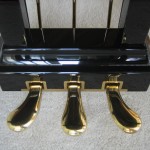
There are typically three pedals on a piano, although you may find slight differences depending on whether it’s a grand, upright, or digital instrument. From left to right, they are usually the soft pedal, the sostenuto pedal, and the sustain pedal.
It’s worth saying straight away that not every piano uses all three pedals in exactly the same way, and some upright pianos even replace the middle pedal with something completely different. So if you’ve ever sat at two different pianos and wondered why the pedals feel or behave differently, you’re not imagining it.
The soft pedal (una corda)
The pedal on the far left is known as the soft pedal, or una corda, which literally means “one string”. It was originally developed by Bartolomeo Cristofori, the inventor of the piano itself.
On the earliest pianos, pressing this pedal physically shifted the keyboard mechanism sideways so that the hammers struck fewer strings. That created a noticeably softer sound, but also changed the colour and character of the tone quite dramatically.
Modern grand pianos still use the same basic idea, but instead of reducing the sound to a single string, it usually reduces the number of strings struck per note. The result isn’t just quieter playing — it also produces a more muted, slightly warmer tone that works beautifully in expressive or delicate passages.
On upright pianos, things are a bit different. The soft pedal doesn’t shift the action sideways. Instead, it moves the hammers closer to the strings so they don’t travel as far before striking. This reduces volume, but it doesn’t change the tone quite as much as a grand piano would.
The middle pedal (sostenuto or practice function)
The middle pedal is where things start to vary quite a lot between instruments.
On a grand piano, this is usually the sostenuto pedal. It allows you to “hold” specific notes while playing others normally. In simple terms, you can play a note or chord, press the pedal, and only those selected notes will continue to ring while everything else behaves normally.
It’s a clever tool, but it’s not used as often as the sustain pedal. Some classical composers did explore it, including Claude Debussy, Maurice Ravel, and Charles Griffes, but in most everyday playing it doesn’t come into use very often.
On upright pianos, the middle pedal is often something completely different. In many cases, it acts as a practice pedal, dropping a strip of felt between the hammers and strings to reduce the volume significantly. On others, it may function as a locking soft pedal or even something entirely model-specific.
So if you’ve ever assumed the middle pedal always does the same job, it really doesn’t.
The sustain pedal (damper pedal)
The pedal on the far right is the sustain pedal, also known as the damper pedal, and this is by far the most important and most widely used pedal on the piano.
When you press it, all the dampers lift off the strings at once, allowing the notes to continue ringing even after you release the keys. This is what makes it possible to connect notes smoothly and create that flowing, legato sound that is so familiar in piano music.
Without the sustain pedal, playing would feel much more broken and separated, because every note would stop the moment you lift your fingers. With it, you can blend chords, overlap harmonies, and create a much richer sound overall.
It also introduces something called sympathetic vibration, where unplayed strings begin to resonate naturally with the notes you are playing. This is part of what gives the piano its depth and warmth when the pedal is used carefully.
Final thoughts
All three pedals have very different roles, but they work together to give the piano much of its expressive power. The sustain pedal shapes the flow of music, the soft pedal changes tone and texture, and the middle pedal adds specialised control depending on the instrument.
Once you start paying attention to them, you realise just how much of piano playing actually happens under your feet as well as in your hands.
Learn to play piano blues online with me
My online blues course teaches blues piano from scratch and builds your ability in a modular way. As you progress through the course, you’ll learn left hands, right hands, bridges and endings which you’ll use together to make your own blues piano compositions. I’ll show you the blues scale early on, giving you everything you need to start improvising – and we’ll progress to advanced licks and an impressive tutorial song to consolidate your new skills. Finally, we’ll move onto some popular blues songs, including music by the great Jerry Lee Lewis and my own personal favourite, Ray Charles.
I charge just £19.99 for 6 full months access, with 58 videos and counting – that’s less than the cost of a single piano lesson! – and I offer a 100% satisfaction money back guarantee.