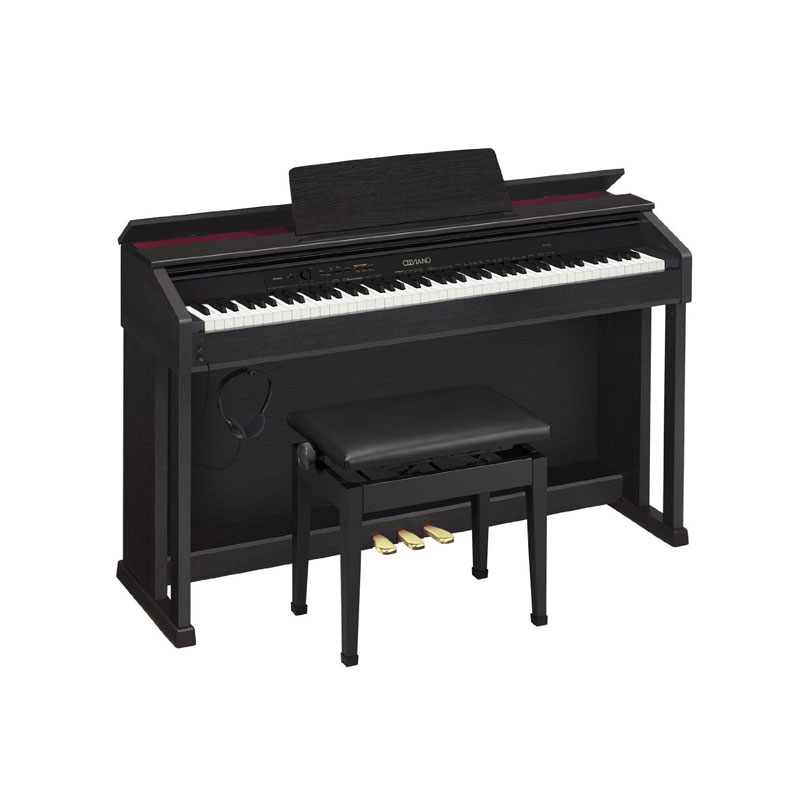
Casio Celviano AP-460BK Review
Casio AP-460BK Sound
When it comes to reviewing the sound of a piano, I am not always sure exactly what I’m looking for. The most obvious things are brightness, the bass, the resonance, and so on. But enjoying the sound of a digital piano can sometimes be down to the individual person.
Sure, if you spend thousands of pounds then you would struggle to find someone that didn’t like the sound, but I find that digital pianos are very much like guitars, and it often comes down to personal choice.
My first impressions of how a piano sounds is usually the right one – and I was happy! I like bright piano sounds as I am a keen blues and boogie woogie player, so this type of sound plays to my strengths. I also like an earthy bass sound for the left hand, which the Casio AP-460 delivers.
Another good indication that I like a piano is how long I sit and annoy everyone in the shop for – and I was doing a lot of annoying for quite some time on this piano. I literally spent ages playing as much as I could, from blues to classical, from pop to ballads. I didn’t want to stop, but they unfortunately had a closing time.
The reverb and resonance of this piano is spot on, and the fact that they’ve stereo sampled this from a concert grand is easy to hear. Overall, for less than £1,000 this sounds fantastic, and what I love about the digital piano over a real acoustic is the fact that the sound won’t change over time. It doesn’t need tuning, and it won’t alter if it’s hot or cold. If you fall in love with the sound the second you hear it, you get that sound forever.
A final note in regards to the speakers which are sometimes overlooked during reviews. There is a speaker on each side of the piano, and two additional speakers below a lid at the back. I didn’t actually know about the speakers under the lid at first, until the nice gentleman at the shop showed me. And it’s these kind of features that make a huge difference for me, as it didn’t have to do that.
Does it make a difference to the sound? – absolutely! Especially if you are in a fairly large room. The piano sound suddenly takes on another level and hits you right in the face – in a good way for a change.
So another great little feature to add to an already amazing sound – nice one Casio!
Casio AP-460 touch and feel
The Casio AP-460 as what they call a ‘scaled graded hammer action’ which means the keys are heavier at the bottom, and lighter at the top. Experienced piano players will often welcome this feature, as it adds a very realistic acoustic feel to the keys. However, beginners should also welcome this feature, as it trains the fingers to instantly get used to how a real piano feels when played, and helps with the development of dexterity and control and strength – all hugely important if you want to learn correctly.
I’ve played lots of pianos over the years, and I was very happy with how this felt to play. The keys are very responsive and allow you to play quickly without any skipping or having to wait for the keys. They’ve clearly built this to allow professional players to have no problems at all, and obviously at under £1,000 beginners should opt for this model too and keep it for life – no upgrades needed!
Casio AP-460 features
Not only do you get the expected ‘concert grand’ piano sound, you also get a few other different types. The Casio AP-460 also comes with modern, classic, mellow and bright variations. Not everyone likes or needs to bother with these additional piano sounds, but I love and expect to see these features on a digital piano.
Sometimes playing the same old song over and over again can get a little boring, and instead of learning a new one (which you really should Martin) you can change the piano sound and have a little fun. The ‘mellow’ piano sound for example is one of my favourites, and I love to use this for ballads as well as some classical pieces. Moonlight sonata sounds amazing when using the mellow piano voice as it really does bring down the volume just nicely, and creates an amazing ‘soft’ sound.
As expected nowadays of a digital piano, there are also lots of other voices to select ranging from electric pianos and organs, to vibraphones and strings. I’ve spoken to many people over the years about these additional sounds as I love to use them, but not everyone does. However, they don’t take much convincing when you take a jazz song and use the organ voice, or use strings to play a ballad.
Another great feature is the built in metronome. No longer is there a need to buy this as an additional cost, and you only have to press a button to adjust the time signature as well as the tempo.
There are also 60 in built piano songs to choose from and listen too. A really nice feature if you want to sit at home and let the piano do the work for a change. It’s also a great way for a beginner to find out how the piano sounds before you buy it. If you’ve not been playing for very long or have even never played at all, then it’s nice to sit back and listen to what the piano can really do before you make that all important choice of what to buy for your first ever piano.
Finally, some welcome but expected features are connection for headphones, which is great for practicing quietly. There are also connection ports for PA systems, in case you need to really amp up the volume on stage for example. But one of the best features is the USB connection. You can simply plug a USB stick into the piano and record straight to it. All you have to do then is to plug it into your computer and it will upload in seconds.
Oh, and that reminds me – it also has a two track recording feature. So you can record yourself playing and share it with the world.
Casio AP-460 Price
At around £500 the Casio AP-460 sits nicely in the price bracket for both beginners and professionals. I would highly recommend this to any level of player, and if Casio want to send me one for free for being so nice about there piano, then please get in touch 😉