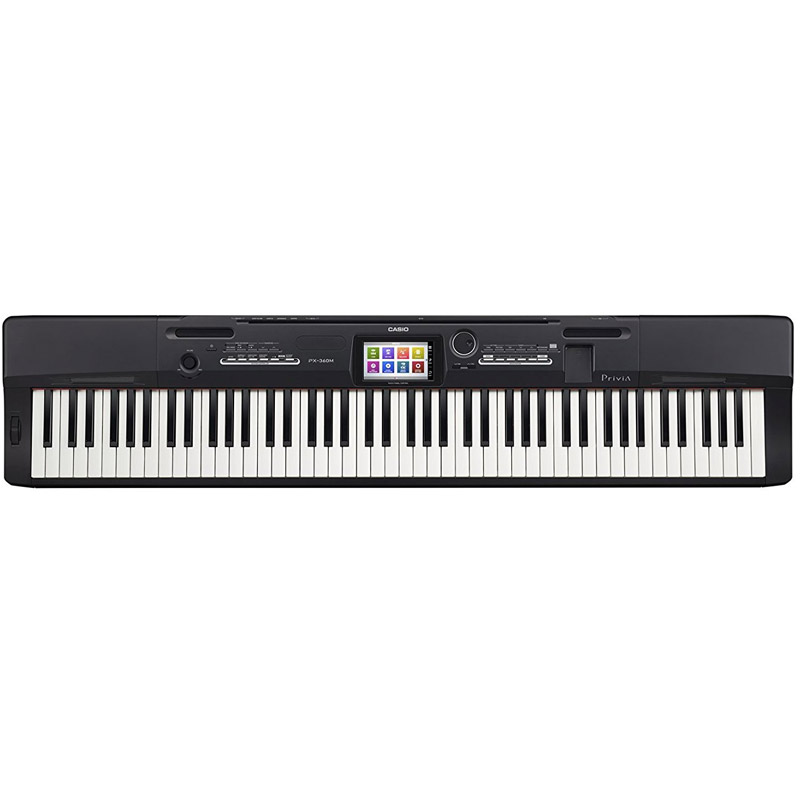
Casio PX-360 Digital Piano review
Sound
Let’s start where we should – the piano sound. There are a few different types to choose from as you would expect, but most people are keen to hear what the main piano voice sounds like – and you wouldn’t be disappointed.
It’s nice and bright, and resonates really well. The reverb function allows the piano sound to carry really nicely, and you can adjust these digital effects if you wish, but I usually find they are set up just right as they are. You can also play around with other digital effects like chorus and brilliance, but again, you would probably be happy to leave them as they are as it sound perfectly fine to me.
This isn’t a feature I have ever messed around with too much in the past, but at least you have the option in case you are not entirely satisfied with the sound. You might prefer it to be brighter for example, so this can be adjusted.
Because the Casio PX-360 sits just under the £1k price level, you would expect it to sound great, and it does. Although I would say that I have played on digital pianos that are cheaper that come close, so it all depends on what the PX-360 has to offer in other areas.
There are well over 500 voices to select, ranging from electric pianos, strings, organs, woodwind, and so on. So you literally have pretty much every instrument and voice covered. However, please bear in mind that if you are only looking to use the piano sound, you would be better with another model that doesn’t have as many sounds and puts more emphasis into the ‘piano’ voice.
I can tell that the sounds have been spread a little thinly here, and although the piano sounds great, it’s the other voices where this piano also shines. So if you looking for a digital piano that offers lots more sounds than just the main piano voice itself, then look no further. But I would say that you don’t really need to spend this much if you are only interested in the piano sound, and could probably get something cheaper that sounds just as good.
So on to the other voices – these are a great little feature if this is what you’re looking for. With over 500 to choose from you just can’t go wrong. I personally don’t like to use anything other than organs and strings, but you can still have a lot of fun with these other instruments. The Casio PX-360 also has an auto accompaniment, which allows you to have a backing style playing along with you.
Touch and feel
A lot of effort has gone into the weighting and feel of these keys. There is a synthetic ebony and ivory addition to the keys, which you can really tell the difference. This means that the keys feel the same as a real acoustic piano.
The Casio PX-360 also comes along with what’s called ‘Tri sensor scaled hammer action II’. This is basically a fancy term for keys which are heavier at the bottom, and become gradually lighter as you get to the top. This again is a very welcome feature as it makes the keys feel so realistic when comparing to a real acoustic concert grand piano.
Some may argue that a digital piano’s keys are just not the same when compared to a real acoustic, but I can assure you that the Casio PX-360 offers a very realistic choice when it comes to both sound and touch. I’ve played lots of acoustic pianos that I didn’t like the feel of, and I’ve played lots of digital pianos that I didn’t like the touch and feel of either. So although piano’s have the same number of keys, they are all very different and it can be very much down to personal choice.
Features
I feel that this digital piano is mainly aimed for the player that likes to play along to backing tracks and use lots of other sounds, as well as taking advantage of the great piano sound and 88 keys. The Yamaha offer a CVP range which does this also, and you’ll often find hundreds of voices and drum beats/backing styles. This for example has over 500 voices and 200 rhythm styles.
So again, if you are not interested in playing anything other than the piano, then this wouldn’t be the right digital piano for you. However, if you are specifically looking for this type of piano, then the Casio PX-360 offers everything you need along with quality voices and drums to keep you happy for a very long time.
You also get some really cool functions like ‘layer’ which allow you to play two instruments at the same time. I often use this for piano/strings to get a great effect. The Casio also has an amazing 16 track recording function, which means that you can literally record 16 different voices on top of each other.
Other nice features are the built in metronome to help you keep time and learn how to keep a nice constant rhythm. You also get a transpose feature as well, which can be essential for when playing with a band or singer who like to play a particular song in a different key. So rather than having to have to learn the whole song again in their chosen key, you can just transpose and shift the pitch of the piano to anywhere you like.
The Casio also provides a touch screen colour display which allows you to navigate around all the different voices and rhythms. There is a main menu button which instantly takes you back to the main screen. This is quite a handy feature as you often come across these types of screens that only allow you to keep pressing the back button to get where you want to be.
I have found some of these menus to be difficult to navigate around in the past, but I didn’t have any trouble with this one. Yes, it can take a few minutes to figure out where some of the sounds are, but that would be expected with any digital piano. I can certainly say that it wouldn’t take anyone very long to work out how to access the sounds and rhythms and other features, as everything is clearly labelled and sub-labelled effectively.
Another cool feature is the split, which allows you to literally split the piano into two sections with two different voices. A common choice of voices for example would be the bass in the left hand and the piano in the right. But it doesn’t stop there – you can also use both the layer and the split feature at the same time, allowing you to play a total of four voices at the same time if you wish.
You also get some really nice categories to choose from in the rhythm section of the menu. For example, European, Latin, World, Country, Ballad, and so on. So I love the fact that they have nicely arranged all the rhythms into these categories rather than having to literally search through them all to find what you need.
Price
At around £600 this piano offers a lot for your money. You’d be hard pressed to find another digital piano that offers so many voices, rhythms and recording functions for less. Especially when you compare this instrument to a real acoustic piano which can cost thousands.
Summary
This digital piano leans more towards the experienced player, but also offers everything a beginner would need to. With so many features you can’t help but think that anyone who goes out and performs at concerts or functions like weddings would love this piano.
So you definitely have to know what you’re doing if you want to maximise the potential of this piano with the amazing array of features, however if you like the idea of learning to use the auto accompaniment and you are a beginner, then this would also be great for you too.
If however you only plan to use the piano sound, then certainly look elsewhere as these extra features are just a waste and you really want to look at a digital piano that focuses mainly on the piano sound, and you’d also save a lot of money.