Hi, my name is Martin – the owner of Learn Piano Blues. As a video content creator as well as a private tutor, I often find myself helping beginners (and even more advanced players) push through the frustration of learning to read the bass clef on the piano.
The first clef you learn to read is the treble (typically used for the right hand), and whilst this feels manageable and sometimes relatively straight forward to some, as soon as the student moves to the bass clef they are often left feeling lost and frustrated. If this sounds like you then don’t worry, you’re not alone!
Almost every beginner finds the bass clef a bit awkward at first. It looks unfamiliar, the notes don’t match what you’ve already learned, and your left hand suddenly feels like it’s speaking a different language.
But is there some good news to all of this? Yes, absolutely! Read on to find out how you can overcome the bass clef blues…
So, What Is the Bass Clef?
The bass clef is the set of notes your left hand usually plays. These are the lower, deeper sounds on the piano and often written to the left of middle C.
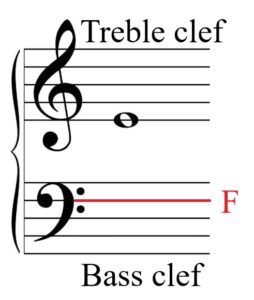
You might also hear it called the F clef. That’s because the symbol circles around the note F, and those two little dots sit either side of the F line. It’s a small detail, but it’s actually a really helpful reference point once you notice it. Having reference points is a great way to begin reading any clef, so starting with the F as shown in the picture below will help you make a good start!
Getting Familiar with the Notes
Let’s break it down in a simple way.
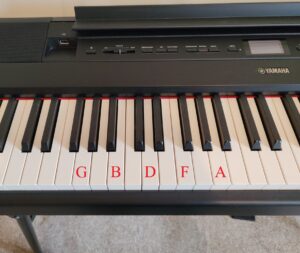
The Lines (bottom to top):
G – B – D – F – A
A lot of people remember this with:
“Good Boys Do Fine Always” or “Good Boys Deserve Fudge Always”
It’s a bit old-school, but it works. And don’t forget, you can of course make up your own!
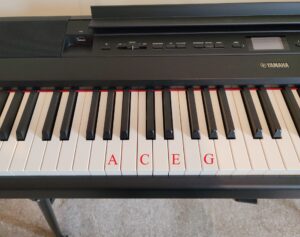
The Spaces (bottom to top):
A – C – E – G
This one’s easier:
“All Cows Eat Grass”
Once you’ve got these two patterns in your head, you’ve already done a big chunk of the work.
Connecting It to the Piano
This is where things start to click.
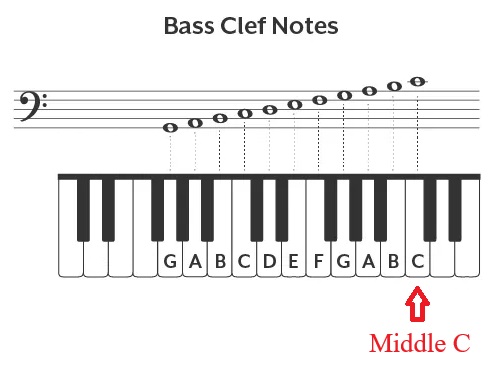
A really useful note to know is Middle C. It sits right between the treble and bass clef. On the piano, it’s roughly in the middle of the keyboard.
From there, you can find your way around by moving step-by-step:
- Go down one note → B
- Down again → A
- Keep going → G, F, and so on
Remember, there are only 7 letters from the alphabet that are used for the names of the musical notes – A, B, C, D, E, F, and G. There is no H, I, J and so on. These 7 notes repeat for each octave and just go higher and higher. So if you can find middle C on the piano (to the left of the two black keys) then you can start to picture how the treble clef sits to the right of that middle C, but more importantly the bass clef sits to the left.
A Simpler Way to Think About It
Here’s something that helps a lot of learners:
You don’t actually need to read every note individually forever.
At the beginning, yes—but over time, you start recognising shapes and patterns instead. Notes that move up step-by-step, small jumps, repeated notes… your brain starts to group them together.
That’s when reading music begins to feel more natural. So don’t panic when you’re looking at the bass clef for the very first time. It will make sense the more you read from it and patterns will emerge relating to the keys and chords of the music you’re playing. But for now, picking out reference points and using this guide will help you get started.
A Few Tips That Actually Help
- Go slower than you think you need to
Rushing just builds bad habits. Take your time and get it right. - Practice your left hand on its own
It might feel boring, but it makes a huge difference later. - Say the notes out loud
It feels a bit strange, but it really helps things stick. - Keep it short but consistent
5–10 minutes a day is far better than one long session once a week. -
If It Feels Hard, That’s Normal
One of the most frustrating parts of learning piano is feeling like your hands aren’t keeping up with your brain—especially with the bass clef.
But this stage doesn’t last forever.
At some point, something clicks. You stop second-guessing every note, your left hand feels more confident, and reading becomes smoother without you even noticing when it happened. There isn’t suddenly a day that you wake up and it all makes sense! Understandably reading any clef takes time. But remember, it will happen. If at any point you feel like it will never make sense then refer back to this guide and take your time. Take it one step at a time and one note at a time.
-
Final Thought
Learning the bass clef isn’t about being “naturally good” at it—it’s just about exposure and repetition.
The more you see it, the more familiar it becomes.
So if it feels slow right now, that’s actually a sign you’re doing it properly. Keep going, and it’ll start to feel a lot more natural sooner than you think.