
Finger numbers are one of those simple ideas in piano playing that end up making a huge difference to how easily you can learn and progress.
At first, it might seem a bit unnecessary to number your fingers at all. After all, you already know which hand you’re using and which finger is which. But once you start reading music properly, you realise very quickly that finger numbers exist for a very practical reason: they help guide you towards the most efficient way of playing a passage.
Why fingers are numbered in piano music
When you look at sheet music, you’ll often notice small numbers written above or below certain notes. These numbers suggest which finger you should use to play that note.
These suggestions aren’t usually placed everywhere in the music. Instead, the composer or editor tends to mark only the parts where fingering might not be immediately obvious. In other words, if there’s an easy or natural hand position, they often leave it up to you — but if there’s a better or more efficient option, they’ll point it out.
It’s important to understand that these markings are generally guidance rather than strict rules. However, in most cases, they are there for a reason. They’ve usually been carefully chosen to make the music smoother, easier to play, or more comfortable for the hand.
I’ll be honest — most of the time I don’t ignore suggested fingering. You only have ten fingers to work with, and good fingering can make a piece feel dramatically easier or harder depending on how you approach it. Every now and again you might find a better alternative that suits your hand, but that’s something worth checking carefully, ideally with a teacher if you have one.
How finger numbering works
Finger numbering is actually very simple once you get used to it.
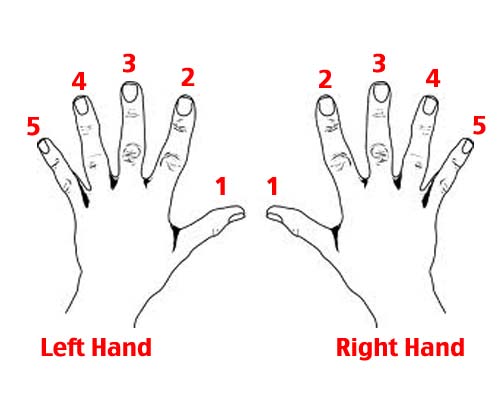
Each hand is numbered separately from 1 to 5:
- Thumb = 1
- Index finger = 2
- Middle finger = 3
- Ring finger = 4
- Little finger (pinky) = 5
So instead of thinking of your fingers as one long set from 1 to 10, each hand works independently. This makes reading and applying fingering much easier, especially when both hands are playing different parts.
Why fingering matters so much
Good fingering isn’t just about following instructions — it directly affects how smoothly you can play.
If you use poor fingering, you’ll often end up:
- jumping awkwardly between notes
- running out of comfortable hand position
- or slowing yourself down unnecessarily
This is where scales become really important as well. Practising scales regularly helps train your fingers to move in a logical, efficient way. Over time, you start to develop natural patterns, so you don’t have to think about every single finger placement.
From a teaching point of view
If you’re learning with a teacher, finger numbers are incredibly useful in lessons. They allow your tutor to correct or guide your hand position quickly without having to explain everything in long detail.
It takes a little while to get used to thinking in numbers, but once it clicks, it makes reading music and learning pieces much more structured and efficient.
Learn to play piano blues online with me
My online blues course teaches blues piano from scratch and builds your ability in a modular way. As you progress through the course, you’ll learn left hands, right hands, bridges and endings which you’ll use together to make your own blues piano compositions. I’ll show you the blues scale early on, giving you everything you need to start improvising – and we’ll progress to advanced licks and an impressive tutorial song to consolidate your new skills. Finally, we’ll move onto some popular blues songs, including music by the great Jerry Lee Lewis and my own personal favourite, Ray Charles.
I charge just £19.99 for 6 full months access, with 58 videos and counting – that’s less than the cost of a single piano lesson! – and I offer a 100% satisfaction money back guarantee.